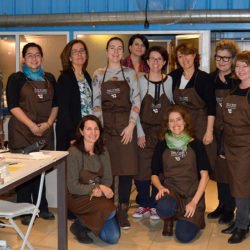
Earlier this month, on November 5, 6, and 7, I had the privilege of teaching the course “Inpainting 360°: Strategies, Materials and Techniques”, organized by the Department of Education and Training at the Museo Nacional Centro de Arte Reina Sofía in Madrid.
During these days, conservators from a range of specialties gathered in the museum’s studios to explore—through hands-on practice and shared reflection—the criteria, materials, and methods that define responsible inpainting. The result was not only a workshop, but a conversation: a collective inquiry into how to restore visual coherence to a damaged work without erasing its history.
The Fine Line between Science and Sensibility
Inpainting is a discipline that exists precisely at the boundary between science and sensibility. It is not about “painting over what was lost,” but about reestablishing the balance of the image while respecting its material and conceptual integrity.
That idea guided each of our sessions, which combined technical demonstrations, historical and theoretical discussions, and a lively ethical debate that unfolded naturally among the participants. The energy and technical depth of the group made every exchange meaningful.


Inpainting: The Challenge of Intervening Without Invading
We began the first day reflecting on the role of inpainting within the larger process of conservation-restoration. I shared with the participants a phrase by Giorgio Vasari that has long stayed with me:
“In truth, it would sometimes be better to keep works done by excellent men in a semi-damaged state than to have them retouched by someone less skilled.”
This warning perfectly encapsulates the spirit of the course. Reintegration does not mean recreating what time or circumstance has erased, but acting with prudence—restoring legibility without falsifying. Every intervention, however minimal, must arise from careful thought, grounded in both technical and ethical reasoning.
Inpainting: From Neutral Tone to Optical Illusion
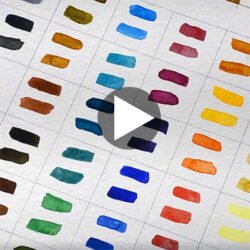
A significant part of the course focused on the chromatic and optical criteria that guide inpainting. We revisited the Italian traditions of rigatino and tratteggio—with their parallel lines visible at close range—as well as puntinatura (stippling), and both neutral and illusionistic approaches.
Each method was analyzed in relation to the artwork’s character and the intended viewing distance, revealing how subtle shifts in technique can determine whether a loss is perceived as a quiet absence or as a seamless continuity.
Understanding color perception was central to our discussions. We explored color relationships inspired by the teachings of Joseph Albers, emphasizing how context affects perception and the importance of visual training for restorers. We also examined the phenomena of metamerism—where colors match under one light but appear different under another—and considered the implications of this fact in practical decision-making. Awareness of these factors is crucial when selecting inpainting tones, ensuring that color choices remain consistent and perceptually accurate under different lighting conditions and for diverse viewers.
Material as a Point of Departure
Before discussing color, it is essential to understand the original material. Part of the course was devoted to the study of paint layers, the preparation of fills, and the selection of reversible materials.
We examined traditional bases such as gesso and animal glue, alongside more stable synthetic formulations—always considering their compatibility with original materials. Particular attention was paid to texture, often overlooked yet just as vital as tone.
A reintegration may be chromatically perfect, but if the surface fails to echo the artist’s gesture or the surrounding grain, it will immediately feel foreign. In restoration, texture speaks as eloquently as color.

Ethics in Practice
No discussion on inpainting would be complete without addressing its ethical dimension. We examined numerous case studies—particularly from the twentieth century. Each of these examples presented its own dilemma: whether to pursue visual restitution or to accept loss as part of the object’s narrative. These decisions are rarely purely technical; they are interpretive acts, requiring us to listen to the work’s material history and to the artist’s original intention.
A Shared Space for Professional Exchange
Beyond the technical content, what made the course truly rewarding was the exchange of perspectives among professionals. Participants shared thoughts and examples from museum collections, private holdings, and ecclesiastical works. Each approach enriched the discussion, revealing how diverse methodologies converge around common ethical principles.
Inpainting, after all, is not a universal recipe, it is a sum of reasoned judgments. The course became a space to question, refine, and articulate those judgments collectively.
Inpainting: The Art of Discretion
Ultimately, inpainting is an exercise in humility and precision. The restorer strives to disappear, allowing the artwork to speak for itself once again.
At the Museo Reina Sofía, surrounded by works that continuously dialogue between the visible and the absent, this practice took on special resonance. To inpaint is to restore readability without erasing the wound—to reconcile the past with the present.
And above all, it is a reminder that every stroke we add should carry the delicacy of both anonymity and silence.

Text © 2025 Amparo Escolano Mena. Please credit when sharing.